Negative News Screening in Finance: Build a Defensible Risk-Based Program
By Nishit B, Financial Crime Risk Analyst · Updated November 11, 2026 · 6 min read
A customer or business partner may seem low-risk at onboarding, then credible reporting links them to fraud, corruption, sanctions evasion, or another financial crime. That shift can leave a firm asking whether to act, what to verify, and how to avoid treating a headline as fact.
Negative news screening, also called adverse media screening, can help financial firms spot and assess new risks. A news mention alone proves no wrongdoing. Strong programs pair screening with human review, customer due diligence, and clear records of decisions.
This guide explains what screening can and cannot show, how to set its scope, and how to review and measure results. Legal duties and supervisory expectations vary by jurisdiction and institution, so firms need to apply local rules.
Use negative news screening to inform risk decisions
Define adverse media screening’s role
Adverse media screening searches public reporting for information tied to financial crime, integrity, or other risks relevant to a customer relationship. A firm may screen during onboarding and later as part of ongoing monitoring, based on its risk assessment and policy. The results help inform due diligence; they don’t replace it, sanctions checks, or an investigation.
Keep media checks separate from watchlist screening
Sanctions and politically exposed person (PEP) checks compare names against structured lists. Media screening searches news and other public information, which can offer context but does not itself establish a legal ban or a confirmed match. A news story about a person on a sanctions list may be useful background, but the firm must assess the list match through its sanctions process.
Set limits on what a result proves
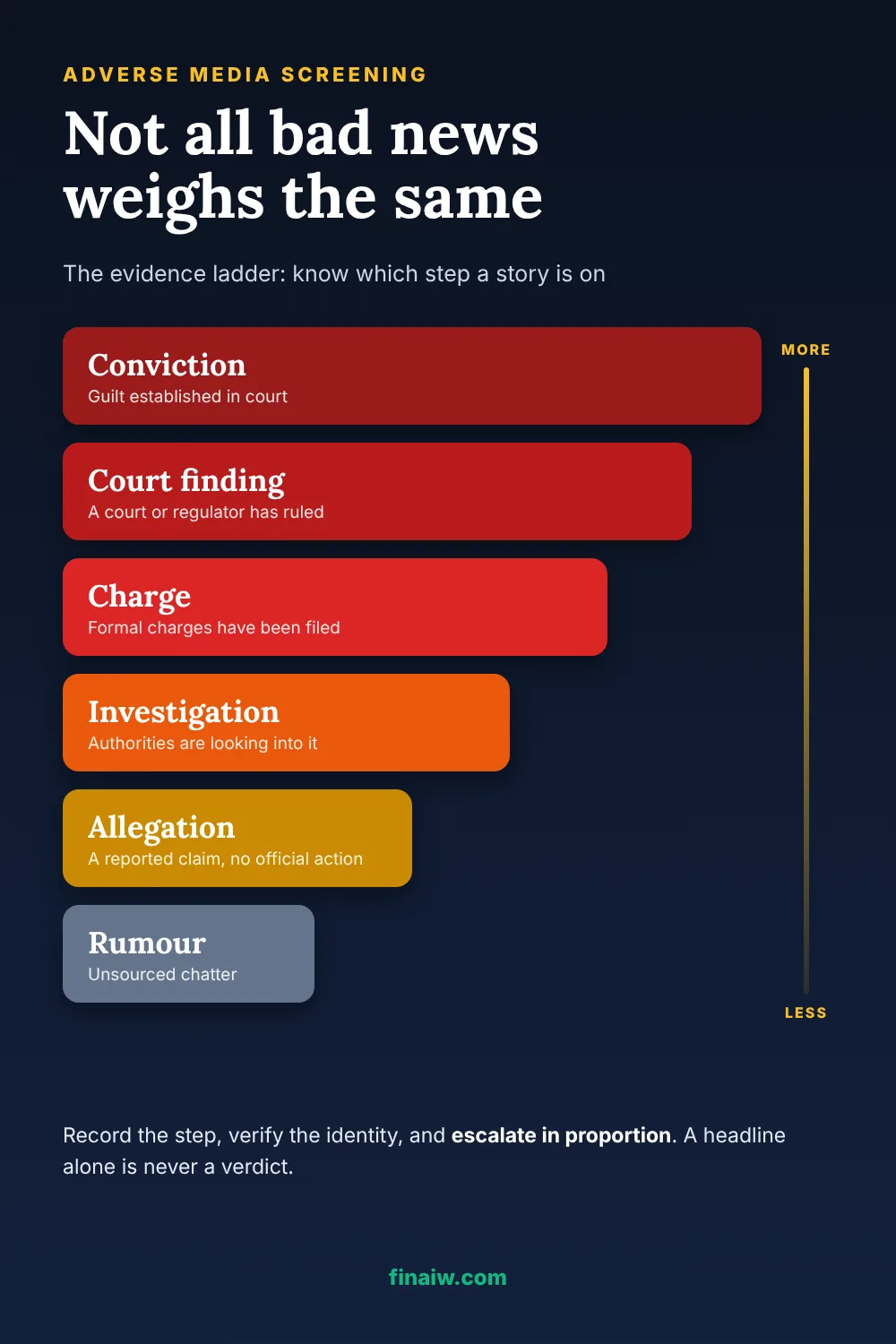
Public coverage is uneven. Some events receive little reporting, while language differences, transliterations, common names, and incomplete records can obscure or confuse a match. Reports can also be outdated or wrong, so analysts should distinguish a rumor or allegation from an investigation, charge, court finding, or conviction.
Design negative news screening around risk and useful sources
Define who and what to screen
Set the scope based on the firm’s business, customer base, geographic exposure, and applicable rules. Depending on the risk, screening may cover customers, beneficial owners, directors, counterparties, or other connected parties. Document who is in scope and why, then review the policy when the business or its risks change.
Select credible, relevant sources
Use sources suited to the firm’s needs, such as established news outlets, court records, government notices, and regulatory publications. Coverage should account for relevant countries, languages, topics, and limits on access. Record where information came from; source provenance helps analysts judge reliability and helps reviewers repeat the search.
Tailor search terms to the business
Search categories might include corruption, fraud, money laundering, terrorist financing, or organized crime. Terms should fit the firm’s products, customers, and locations rather than come from a fixed list used everywhere. Review local-language terms and spelling variations on a schedule, and update them when new risks emerge.
The FATF’s risk-based approach for the banking sector offers a resource for designing controls around identified risk; its guidance is not a standalone legal mandate for every firm. The Wolfsberg Group’s Negative News Screening FAQs also discuss source reliability, result relevance, alert handling, and governance.
Turn screening alerts into consistent decisions
Verify identity before judging the story
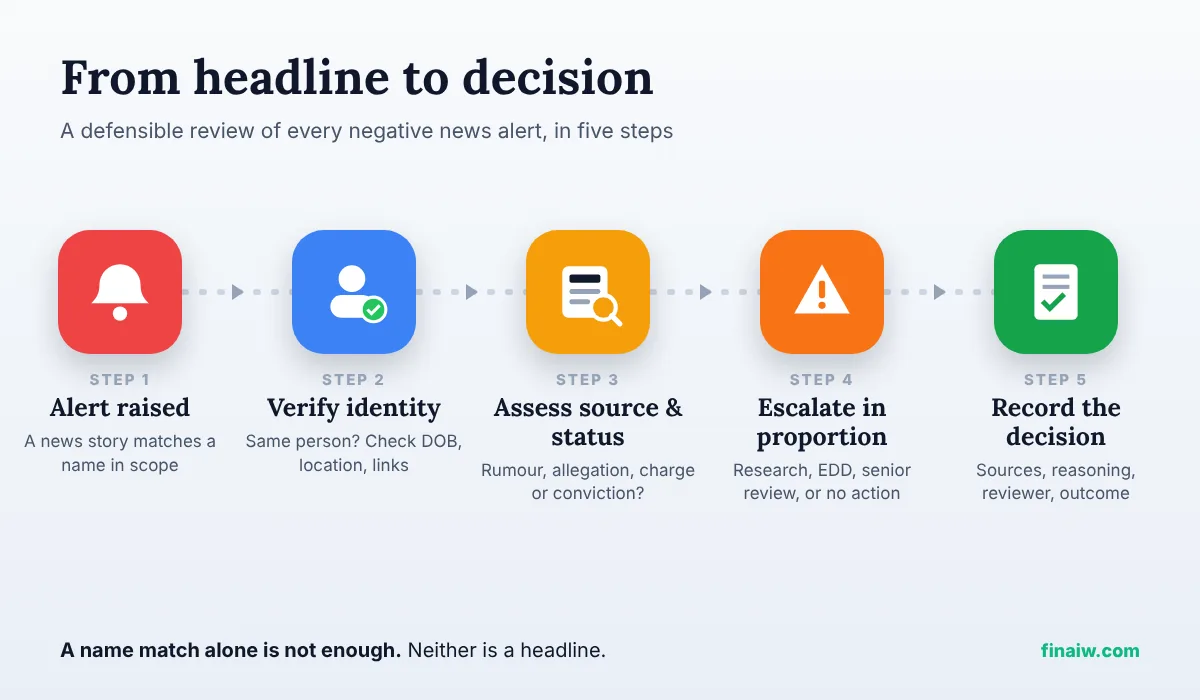
Start by checking whether the report concerns the same person or entity. Compare available details such as date of birth, location, occupation, business links, and known associates. Common names, transliteration differences, and sparse records often create false alerts, so a name match alone is not enough.
Assess the source, status, and relevance
Record who published the report, what it says, when the events took place, and whether other reliable sources confirm the account. Note whether the subject responded and whether later reporting changed the story. Keep allegations separate from official investigations, charges, court findings, and convictions.
Escalate in proportion to the evidence
Depending on the facts, next steps may include further research, enhanced due diligence, or review by a senior compliance officer. A no-action decision can also be sound when the identity does not match or the report lacks relevance; record the reason. Restrictions, reports to authorities, or account exits should follow firm policy and applicable law, not an unverified headline alone.
Govern negative news screening to reduce risk
Set ownership and review standards
Assign clear roles across compliance, operations, data teams, and senior management. Written procedures should define review thresholds, escalation routes, and who can approve a final decision. Train analysts to separate evidence from inference and to apply the same standards across cases.
Protect personal data and treat people fairly
Screening can involve sensitive personal information, so collect and retain only what the firm needs under applicable rules. Use access controls and retention limits, and check local data-protection and consumer-protection duties with qualified legal and compliance teams. Review mistaken identity and stale reporting carefully to reduce unfair outcomes.
Keep a clear audit trail
A useful case record includes the alert, sources checked, identity comparison, risk assessment, reviewer, escalation, and final reason. These records help quality teams spot inconsistent decisions and allow the firm to explain its process during supervisory review. Keep enough detail to support later review without storing unnecessary personal data.
Measure screening quality and improve it
Track measures that reveal friction
Review alert volume, repeat false-positive patterns, time to close cases, escalation rates, and quality-check findings. No single measure proves a program works; a high alert count may mean broad coverage, poor matching, or both. Look at trends alongside changes in customer mix, risk, and analyst capacity.
Test sources, workflows, and providers
Check that chosen sources remain current and relevant across key languages and locations. Test how well matching works for people and entities, and review whether case tools preserve key decisions and records. If a vendor provides screening data, assess its methods and service performance while keeping responsibility for the firm’s decisions.
Use results to update rules and training
Quality reviews and new risks may show that search terms, source coverage, or analyst guidance need changes. Document why each change was made and check its effect on alert quality, review time, and missed-risk concerns. This creates a practical feedback loop instead of relying on alert volume as a measure of success.
Frequently asked questions
What is negative news screening?
Negative news screening, also called adverse media screening, searches public reporting for information tied to financial crime, integrity or other risks relevant to a customer relationship. It informs due diligence but doesn't replace it, sanctions checks or an investigation.
How is adverse media screening different from sanctions or PEP screening?
Sanctions and PEP checks compare names against structured lists. Media screening searches news and other public information. It can add context, but it doesn't by itself establish a legal ban or a confirmed list match.
Does a negative news hit mean we should reject the customer?
No. A news mention alone proves no wrongdoing. First confirm it's the same person or entity, then assess the source and whether the story is a rumour, allegation, investigation, charge, court finding or conviction, and escalate in proportion to the evidence.
When should firms run negative news screening?
At onboarding and, where the firm's risk assessment and policy call for it, as part of ongoing monitoring.
What should a negative news case record include?
The alert, sources checked, identity comparison, risk assessment, reviewer, any escalation and the reason for the final decision.
Conclusion
Negative news screening is most useful as one input to risk-based due diligence, not an automated verdict. Select relevant sources, verify identity, assess what the reporting establishes, escalate in proportion to the evidence, and record the decision. Review the program against your firm’s risks and local requirements. Use the next policy review to check whether its sources, search terms, and case records still support careful, consistent decisions.
About the author: Nishit B (MBA in Finance) is a co-founder of FINAIW and works as a Financial Crime Risk Analyst. More about the FINAIW team.
Disclaimer: This article is for general education only and is not legal, regulatory or compliance advice. Requirements differ by jurisdiction and institution; firms should confirm their obligations with qualified legal and compliance professionals.