EMI for Every Loan Amount: The Complete Table by Rate and Tenure
By FINAIW Team · Reviewed by Nishit B, Founder, and Shilp G, Co-founder · Updated October 29, 2026 · 6 min read
For every 100,000 you borrow at 9% interest over 20 years, your EMI is about 900 a month. The amount scales directly with how much you borrow — a 1,000,000 loan on the same terms costs ten times that, about 9,000 a month. The numbers below work in any currency, at any loan size: dollars, euros, rupees, dirhams, or anything else.
Below is the complete table — every common interest rate, every common tenure — so you can read off your own EMI in seconds, plus how it changes if you borrow more, stretch the tenure, or get a better rate.
EMI per 100,000 borrowed: the full table
| Rate | 5 yrs | 10 yrs | 15 yrs | 20 yrs | 25 yrs | 30 yrs |
|---|---|---|---|---|---|---|
| 7.0% | 1,980 | 1,161 | 899 | 775 | 707 | 665 |
| 7.5% | 2,004 | 1,187 | 927 | 806 | 739 | 699 |
| 8.0% | 2,028 | 1,213 | 956 | 836 | 772 | 734 |
| 8.5% | 2,052 | 1,240 | 985 | 868 | 805 | 769 |
| 9.0% | 2,076 | 1,267 | 1,014 | 900 | 839 | 805 |
| 9.5% | 2,100 | 1,294 | 1,044 | 932 | 874 | 841 |
| 10.0% | 2,125 | 1,322 | 1,075 | 965 | 909 | 878 |
| 11.0% | 2,174 | 1,378 | 1,137 | 1,032 | 980 | 952 |
| 12.0% | 2,224 | 1,435 | 1,200 | 1,101 | 1,053 | 1,029 |
Every figure is the monthly EMI for every 100,000 borrowed, using the same reducing-balance formula as the FINAIW EMI Calculator above.
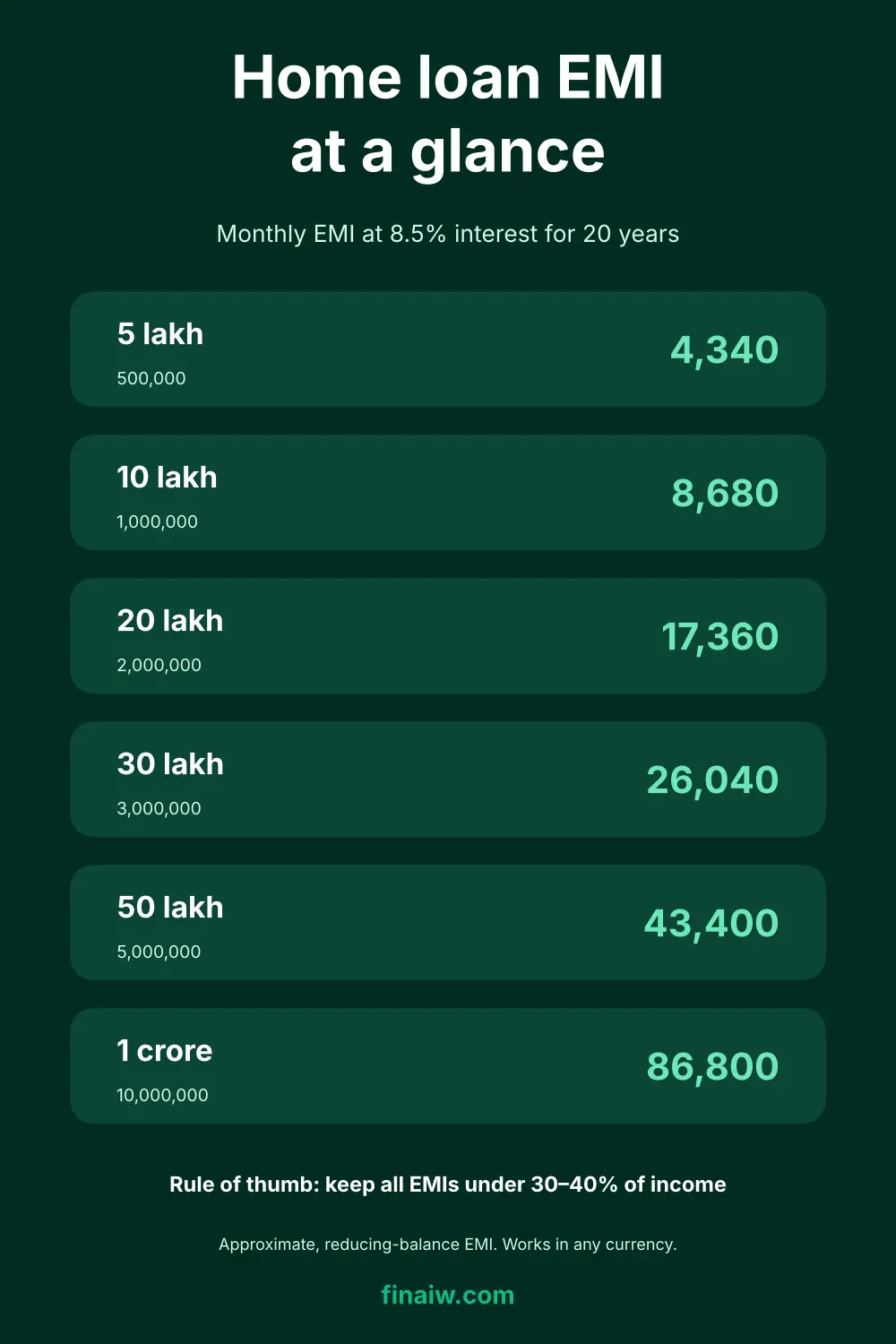
EMI for common loan amounts (8.5%, 20 years)
| Loan amount | Monthly EMI |
|---|---|
| 5 lakh (500,000) | about 4,340 |
| 10 lakh (1,000,000) | about 8,680 |
| 20 lakh (2,000,000) | about 17,360 |
| 30 lakh (3,000,000) | about 26,040 |
| 50 lakh (5,000,000) | about 43,400 |
| 1 crore (10,000,000) | about 86,800 |
Find your exact number in 30 seconds.
Plug in your exact loan amount, rate and tenure — the FINAIW EMI Calculator works in any currency.
Open the EMI Calculator →How to scale this to your actual loan amount
The table is built around a clean unit — 100,000 — specifically so it scales by simple multiplication. Find your rate and tenure, read the EMI per 100,000, then multiply by how many 100,000s you're actually borrowing.
Worked examples, all read straight from the table above:
- 10 lakh (1,000,000) at 9% for 20 years: 900 × 10 = about 9,000/month
- 20 lakh (2,000,000) at 8.5% for 20 years: 868 × 20 = about 17,360/month
- 50 lakh (5,000,000) at 8.5% for 20 years: 868 × 50 = about 43,400/month
- 1 crore (10,000,000) at 8.5% for 20 years: 868 × 100 = about 86,800/month
- 500,000 at 9% for 20 years: 900 × 5 = about 4,500/month
- 300,000 at 7% for 30 years (a typical long-tenure mortgage): 665 × 3 = about 2,000/month
If your exact rate falls between two rows, or your exact amount doesn't divide evenly into 100,000s, the EMI Calculator gives you the precise figure instantly — the table is for quick estimates without reaching for a calculator at all.
How EMI is actually calculated
Every number above comes from the standard reducing-balance formula every bank and home loan uses:
EMI = [P × R × (1 + R)^N] ÷ [(1 + R)^N − 1]
Here, P is the loan amount, R is the monthly interest rate (annual rate ÷ 12 ÷ 100), and N is the number of monthly payments (years × 12). "Reducing balance" means interest is charged only on what you still owe, not on the original loan amount — which is why your EMI stays flat but the split between interest and principal inside it shifts every month: mostly interest at the start, mostly principal by the end.
The real cost: total interest paid, not just the EMI
A lower EMI from a longer tenure looks appealing, but it isn't free — you pay for it in total interest. Here's the total interest paid per 100,000 borrowed, at the same rates and tenures:
| Rate | 5 yrs | 10 yrs | 15 yrs | 20 yrs | 25 yrs | 30 yrs |
|---|---|---|---|---|---|---|
| 7.0% | 18,807 | 39,330 | 61,789 | 86,072 | 112,034 | 139,509 |
| 8.0% | 21,658 | 45,593 | 72,017 | 100,746 | 131,545 | 164,155 |
| 9.0% | 24,550 | 52,011 | 82,568 | 115,934 | 151,759 | 189,664 |
| 10.0% | 27,482 | 58,581 | 93,429 | 131,605 | 172,610 | 215,926 |
| 12.0% | 33,467 | 72,165 | 116,030 | 164,261 | 215,967 | 270,301 |
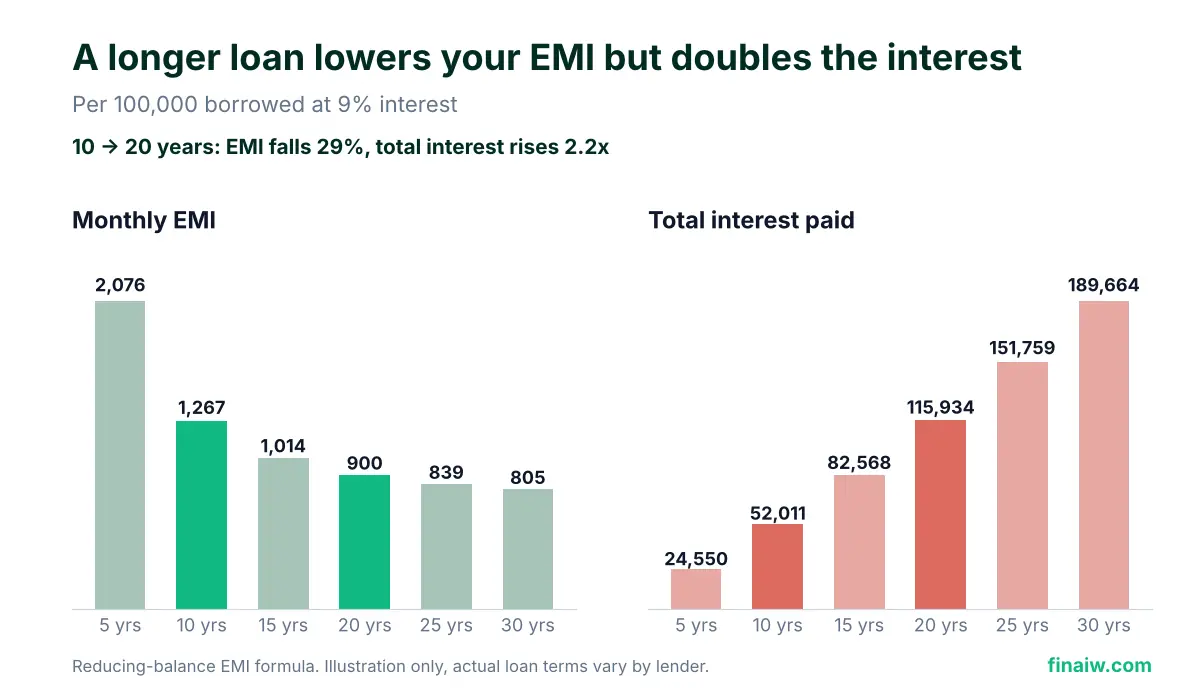
Take a 100,000 loan at 9%: stretching the tenure from 10 to 20 years lowers your EMI by about 29% (1,267 → 900), but the total interest you pay more than doubles — 2.23 times as much (52,011 → 115,934). A shorter tenure costs more per month and far less overall; a longer one is the opposite. There's no free lunch, only a trade-off between monthly comfort and total cost.
A common rule of thumb: keep your total EMIs at 30–40% of monthly income or less. The Home Affordability Calculator tests a specific property price against exactly that limit.
Flat rate vs reducing balance — the trap to watch for
Some lenders, especially for personal, vehicle, or gold loans, quote a "flat rate" instead of the reducing-balance rate used throughout this article. A flat rate charges interest on the full original loan amount for the entire tenure, even though you're steadily paying it down — which makes the real, reducing-balance-equivalent rate significantly higher than the flat number quoted. Always ask a lender to state their rate on a reducing-balance basis before comparing it against the table above; comparing a flat-rate offer directly to these figures will understate what you're actually paying.
Frequently asked questions
What is the EMI for a 10 lakh loan at 9% for 20 years?
About 9,000 a month (900 per 100,000 borrowed, × 10). Use the table above for other rates and tenures, or the EMI Calculator for an exact figure.
What is the EMI for a 50 lakh home loan?
At 8.5% over 20 years, about 43,400 a month. At 9% it's about 45,000; at 8% it's about 41,800. Home loan rates and the exact amount both move the figure, so check the full table above for your specific terms.
What is the EMI for a 30 lakh home loan?
About 26,040 a month at 8.5% for 20 years. At 9% it's about 27,000.
What is the EMI for a 1 crore home loan?
About 86,800 a month at 8.5% for 20 years. At 9% it's about 90,000.
Does a longer tenure reduce my EMI?
Yes, but not proportionally, and it increases total interest significantly. Going from a 10-year to a 20-year tenure at 9% lowers the monthly EMI by about 29% but more than doubles the total interest paid over the life of the loan.
Is a flat interest rate the same as a reducing-balance rate?
No. A flat rate is charged on the original loan amount for the whole tenure; a reducing-balance rate (what this table and nearly all home loans use) is charged only on the outstanding balance. A flat rate quoted at the same number as a reducing rate is always more expensive — ask your lender which basis they're quoting.
How much EMI can I afford?
A common guideline is to keep all your EMIs combined at 30–40% of your monthly income or less. The Home Affordability Calculator checks a specific home price against your income using this rule.
The bottom line
EMI scales predictably with loan amount, rises with rate, and falls — slowly, not proportionally — as tenure stretches out. The table above covers every common combination so you can estimate your own EMI in seconds; the trade-off to actually decide on is monthly comfort against total interest paid, not the headline EMI number alone.
Planning to invest the difference instead? See How much to invest to become a millionaire.
Get your exact EMI in seconds with the FINAIW EMI Calculator →
New to how loans work? Read our lesson on Home Loan Basics.
Disclaimer: This article is for education only and is not financial or lending advice. Figures are illustrations using the standard reducing-balance EMI formula; actual loan terms, fees, and eligibility vary by lender. Please compare offers from licensed lenders directly before borrowing.
Find your exact number in 30 seconds.
Plug in your exact loan amount, rate and tenure — the FINAIW EMI Calculator works in any currency.
Open the EMI Calculator →