How Much Do You Need to Invest Each Month to Become a Millionaire?
By FINAIW Team · Reviewed by Nishit B, Founder, and Shilp G, Co-founder · Updated October 24, 2026 · 7 min read
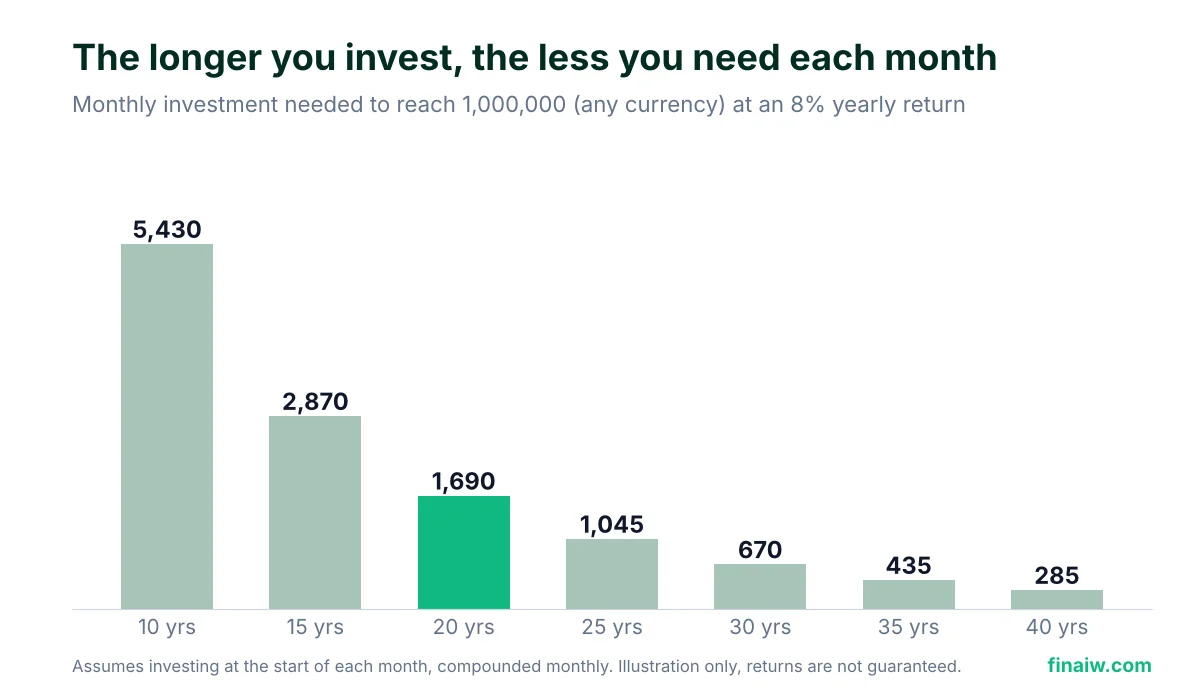
To reach 1 million, you need to invest about 1,690 a month for 20 years, or 670 a month for 30 years, or 285 a month for 40 years. All three assume an 8% average yearly return. The numbers work in any currency: dollars, pounds, euros, dirhams or anything else.
More people are getting there than ever. A record 769,000 Fidelity 401(k) accounts in the US crossed $1 million in mid-2026. In India, monthly investing through SIPs hit an all-time high in September 2026. What these investors share isn't a big salary. It's a fixed amount invested every month for a long time.
Below are the exact monthly amounts for 10 to 40 years, what changes if returns are lower, how to use the table in your own currency, and what 1 million will really be worth when you get there.
Quick answer: monthly investment to reach 1 million
| Time to goal | Monthly investment (8% return) | Total you put in | Growth from returns |
|---|---|---|---|
| 10 years | 5,430 | 651,600 | 348,400 |
| 15 years | 2,870 | 516,700 | 483,300 |
| 20 years | 1,690 | 404,800 | 595,200 |
| 25 years | 1,045 | 313,400 | 686,600 |
| 30 years | 670 | 240,000 | 760,000 |
| 35 years | 435 | 181,900 | 818,100 |
| 40 years | 285 | 136,600 | 863,400 |
Look at the last column. Over 10 years, returns make up about a third of your million. Over 40 years, they make up more than 85%. That is compounding: your returns start earning returns of their own.
Want your own numbers? The FINAIW SIP Calculator works for any monthly investment, in any currency. Change the currency in Settings.
Find your exact number in 30 seconds.
Plug in your own timeline and return assumption — the FINAIW SIP Calculator works in any currency.
Open the SIP Calculator →How the monthly amount is calculated
When you invest every month, each payment grows for a different length of time. Your first one grows for the full period; your last one grows for just a month. The standard formula adds all of those up:
FV = P × [((1 + i)^n − 1) ÷ i] × (1 + i)
Here, FV is the final value (1,000,000), P is your monthly investment, i is the monthly return (8% ÷ 12), and n is the number of months. The figures here assume you invest at the start of each month and returns compound monthly. You don't need to do the maths by hand, but it helps to know there's no magic in it.
What if returns are lower (or higher)?
Nobody can promise 8%. The US S&P 500 has averaged about 10% a year since 1957, but it has had many negative years along the way, and other markets have done better or worse. Plan with a range, not a single number.
| Time to goal | At 6% | At 8% | At 10% |
|---|---|---|---|
| 10 years | 6,070 | 5,430 | 4,840 |
| 15 years | 3,420 | 2,870 | 2,390 |
| 20 years | 2,150 | 1,690 | 1,310 |
| 25 years | 1,440 | 1,045 | 750 |
| 30 years | 990 | 670 | 440 |
| 35 years | 700 | 435 | 260 |
| 40 years | 500 | 285 | 160 |
Over 10 years, the return makes a modest difference. Over 40 years, a 6% return needs more than three times the monthly amount of a 10% return. Time does more of the work than the return does.
A safe habit: plan at the low end, hope for the middle. If returns come in higher, you reach your goal early.
Using this table in your currency
The table shows the amount needed for 1,000,000 of any currency, because the maths only depends on time and return. A few notes:
- US dollars, pounds, euros, Canadian or Australian dollars, dirhams: read the table as it is.
- A different target: scale it. For 500,000, halve the amounts; for 2 million, double them.
- Indian rupees and ₹1 crore: 1 crore is 10 million, so multiply the amounts by 10. At 8%, that's about ₹16,900 a month for 20 years.
- Pick a return that fits your economy. In countries with higher inflation, such as India, investments usually grow faster in nominal terms, so planners often assume 10–12%. In lower-inflation economies, 6–8% is a more common assumption.
How long will your monthly investment take?
Flip the question around. If you already have a monthly amount in mind, here's how long it takes to reach 1 million at 8%:
| Invested every month | Years to 1 million |
|---|---|
| 250 | about 41½ |
| 500 | about 33 |
| 1,000 | about 25½ |
| 1,500 | about 21 |
| 2,000 | about 18 |
Doubling from 500 to 1,000 a month doesn't halve the time. It saves about 8 years. Compounding needs time, and money alone can't fully replace it.
Starting late costs more than you think
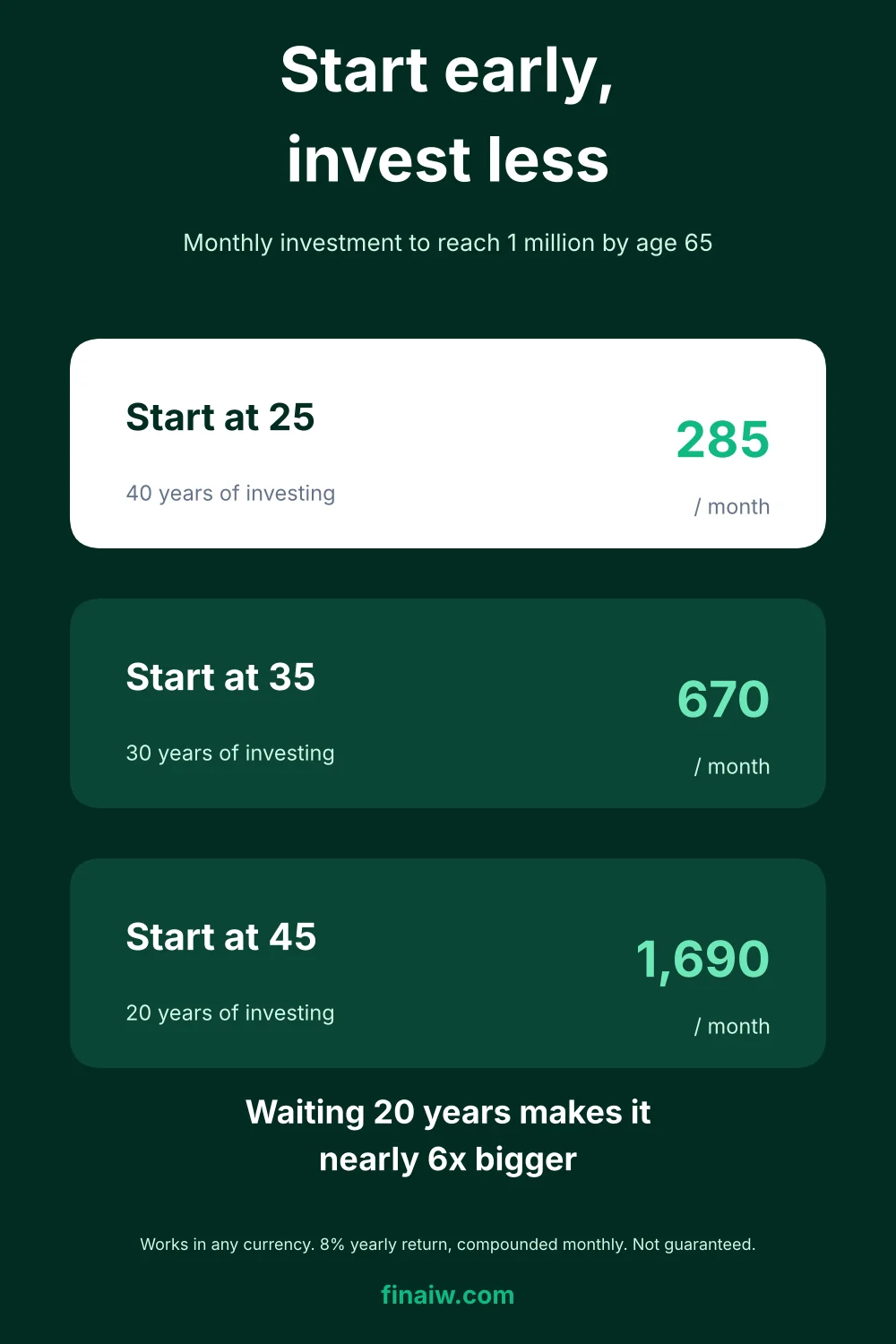
Say you want 1 million by age 65, at an 8% return:
- Start at 25, and you need about 285 a month.
- Start at 35, and you need about 670 a month.
- Start at 45, and you need about 1,690 a month.
Waiting 10 years more than doubles the monthly amount. Waiting 20 years makes it nearly six times bigger. If you're in your twenties, a small amount today beats a big amount later.
Raise it every year
Most people's income grows, but a fixed monthly investment stays flat. Raising it by a set percentage every year (called a "step-up" in India; many apps and workplace plans offer an automatic increase) lets you start smaller.
With a 5% increase every year and an 8% return:
| Time to goal | Fixed monthly amount | Starting amount with 5% yearly increase |
|---|---|---|
| 20 years | 1,690 | 1,160 |
| 30 years | 670 | 400 |
| 40 years | 285 | 155 |
One honest catch: you put in more money in total this way. Over 30 years, it's about 317,000 instead of 240,000, because your later payments are larger and have less time to grow. The benefit is that you can start at a level you can afford today and grow it with your income.
What will 1 million really be worth?
This is the part most articles skip. Prices rise every year, so 1 million in the future buys less than 1 million today. At 3% yearly inflation:
| 1 million received in | Worth in today's money |
|---|---|
| 10 years | about 744,000 |
| 20 years | about 554,000 |
| 30 years | about 412,000 |
| 40 years | about 307,000 |
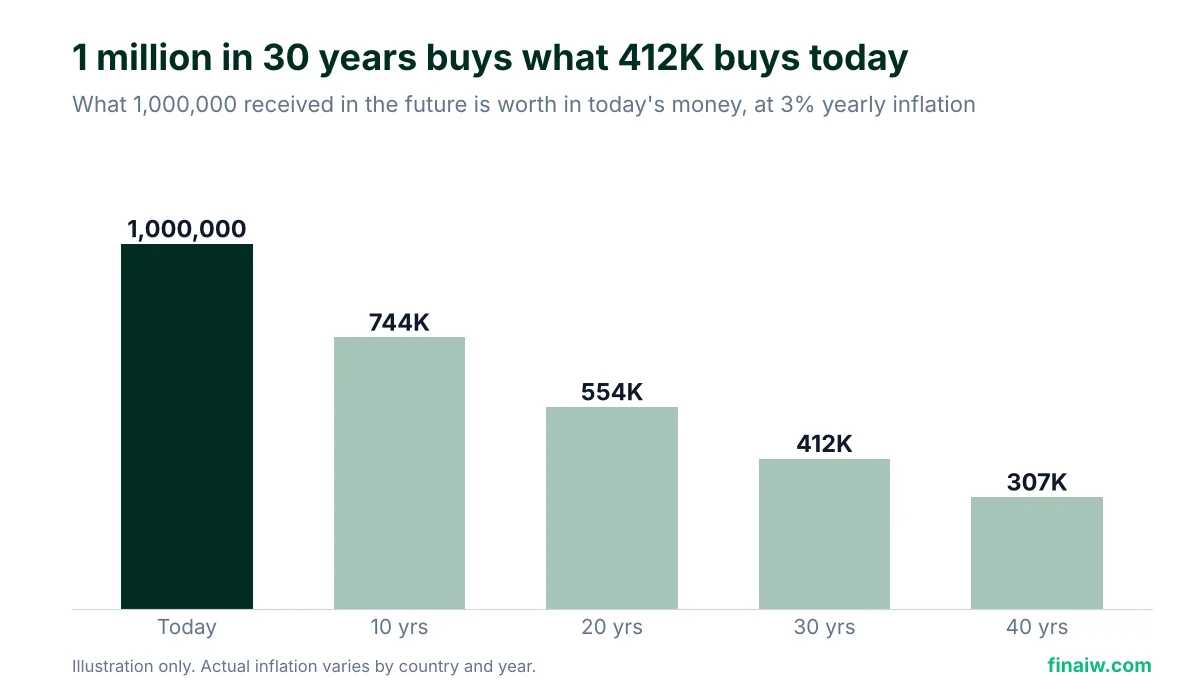
That doesn't make 1 million a bad goal. It means your real target should come from what you'll actually need: your future expenses, your retirement age, your family's plans. The FIRE Calculator works out a retirement target for you. To see where you stand today against people worldwide, try the Global Net Worth Percentile tool.
Use your country's tax-friendly accounts
Taxes can take a real bite out of your returns, so invest through accounts your country rewards when you can. Examples include a 401(k) or IRA in the US, an ISA or pension in the UK, a TFSA or RRSP in Canada, superannuation in Australia, and ELSS, PPF or NPS in India. Rules and limits differ by country and change over time, so check the current ones where you live.
Five habits that get you to 1 million
- Start now, even small. A small amount you actually invest beats a big amount you plan to start next year.
- Automate it. Schedule the investment for the day after payday so the money leaves before you can spend it.
- Raise it every year. Set an automatic yearly increase, or raise it by hand with every pay rise.
- Don't stop when markets fall. Falling prices mean your monthly amount buys more. Stopping then is the most common way people miss their goal.
- Review once a year, not once a day. Check that your investments still fit your goal. Daily checking mostly leads to panic.
Frequently asked questions
How much do I need to invest per month to become a millionaire in 20 years?
About 1,690 a month at an 8% yearly return. At 6% you need about 2,150, and at 10% about 1,310. The amounts work in any currency.
How long does it take to become a millionaire investing 500 a month?
About 33 years at an 8% yearly return.
How long does it take to become a millionaire investing 1,000 a month?
About 25½ years at an 8% yearly return.
Is an 8% return realistic?
It's a common planning figure for a stock-heavy portfolio over long periods, but it isn't guaranteed. The S&P 500 has averaged about 10% a year since 1957, with big swings between years. Plan with a range, such as 6% to 10%.
Does this work for rupees and 1 crore?
Yes. 1 crore is 10 million, so multiply the table amounts by 10. In higher-inflation economies like India, planners usually assume higher returns, around 10–12%.
Will 1 million be enough in 30 years?
At 3% inflation, 1 million in 30 years buys about what 412,000 buys today. Set your target from your future expenses, not the round number.
Related: The janitor who died with $8 million
The bottom line
Becoming a millionaire is within reach for most people with a steady income, in almost any country. The amount you need depends far more on when you start than on how much you earn. Pick your timeline from the table, start an amount you can keep up even in bad months, and raise it every year.
Find your exact number in 30 seconds with the FINAIW SIP Calculator →
New to compounding? Read our lesson on Compound Interest.
Disclaimer: This article is for education only and is not investment advice. Figures are illustrations using a constant return compounded monthly; real returns vary and investments can lose value. Tax rules differ by country. Please speak to a licensed financial adviser in your country for personal advice.
Find your exact number in 30 seconds.
Plug in your own timeline and return assumption — the FINAIW SIP Calculator works in any currency.
Open the SIP Calculator →