The Janitor Who Died With $8 Million (and the Banker Who Went Broke)
By FINAIW Team · Reviewed by Nishit B, Founder, and Shilp G, Co-founder · Updated October 30, 2026 · 8 min read
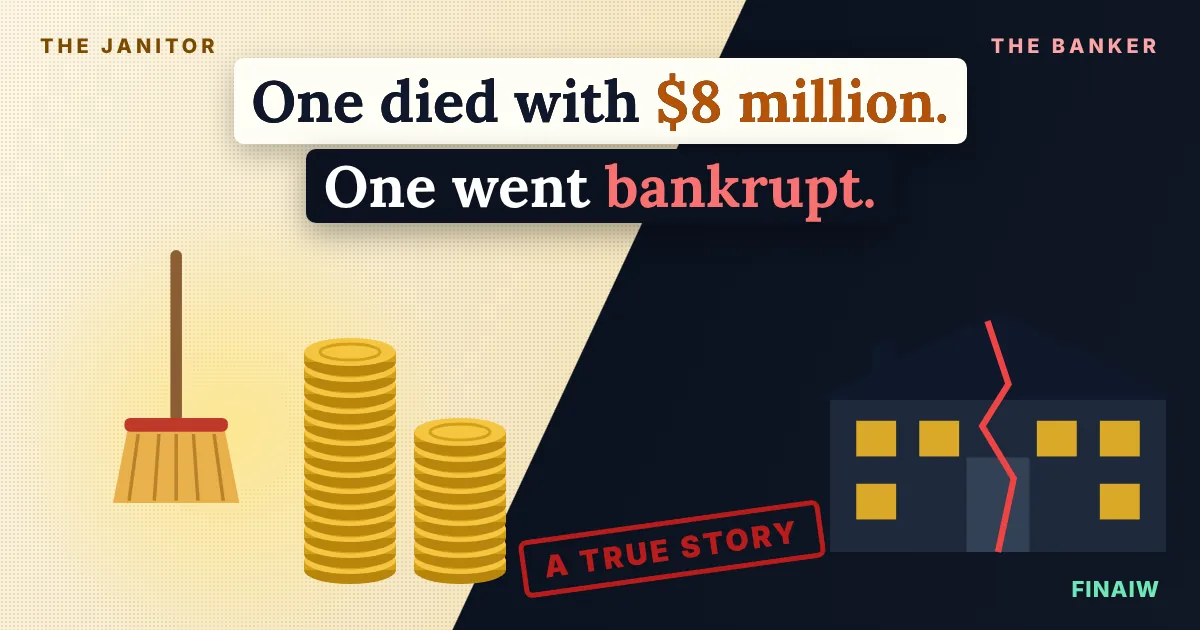
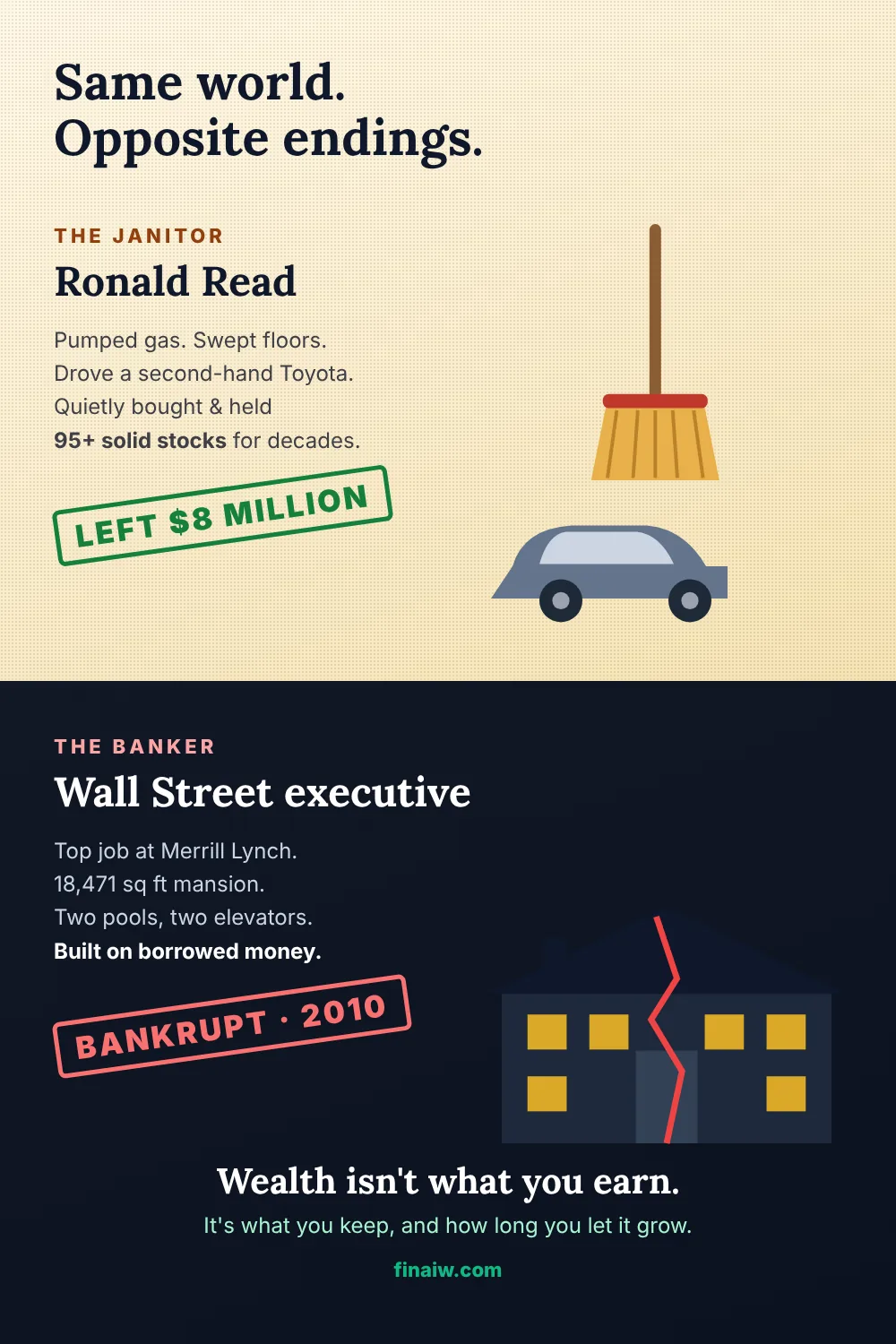
In June 2014, a 92-year-old man died in Brattleboro, a small town in Vermont. He'd spent his working life pumping gas and, later, sweeping floors as a janitor at a JCPenney store. He drove a second-hand Toyota. He held his coat together with safety pins. He was still chopping his own firewood in his nineties. Then his will was read, and the town found out that Ronald Read had left behind about $8 million.
A few years earlier, a very different man made the news. Richard Fuscone had been head of Latin America at Merrill Lynch, a top job at one of Wall Street's biggest firms. In 2010, he filed for personal bankruptcy to stop the auction of his 18,471-square-foot mansion: two swimming pools, two elevators, eleven bathrooms, a seven-car garage.
The janitor died rich. The banker went broke. If wealth were about how much you earn, this would be impossible. It isn't impossible, because wealth was never about how much you earn. It's about what you do with what you earn, and for how long.
(This pairing is famous from Morgan Housel's book The Psychology of Money. If you haven't read it, it's worth your time.)
The janitor nobody noticed
Ronald Read was the first person in his family to finish high school. He served in World War II in North Africa, Italy and the Pacific, came home, and went to work. Nothing about his life looked like money.
But quietly, for decades, he bought shares of solid, boring companies: Procter & Gamble, Johnson & Johnson, J.M. Smucker, CVS. When he died he owned at least 95 different stocks, many of them held for years or decades. He didn't trade. He didn't panic. He just kept buying and kept holding, and the dividends kept coming.
A friend summed him up like this: "I'm sure if he earned $50 in a week, he probably invested $40 of it."
He left $4.8 million to his local hospital and $1.2 million to the town library. The library invested most of its gift so it keeps paying out year after year, which is fitting, because that's exactly how Read built it.
The banker who had everything
Richard Fuscone's story is the mirror image. He had the education, the title and the pay. What he didn't have was room for error.
His lifestyle ran on borrowed money: the mansion carried a mortgage that ended up in foreclosure. When the 2008 financial crisis hit, he wrote in his bankruptcy filing that he had been "personally devastated". The mansion went up for sale at $13.9 million and found no buyer. The list of people he owed money to included a private school, American Express, Mercedes-Benz, a local hardware store and a pet shop.
Fuscone wasn't stupid. By most measures he was far more financially sophisticated than Ronald Read. The difference wasn't knowledge. It was behaviour.
"That's one lucky guy." Except it keeps happening.
It would be easy to call Ronald Read a one-off. He isn't.
Grace Groner worked 43 years as a secretary at Abbott Laboratories, and in 1935 bought $180 of Abbott stock. She never sold. She lived in a one-bedroom house, bought her clothes at rummage sales and walked instead of owning a car. When she died in 2010, aged 100, that $180 had grown into about $7 million, which she left to her old college to pay for students' internships and study-abroad trips. That works out to roughly 15% a year, every year, for 75 years.
Sylvia Bloom joined a Wall Street law firm as a secretary in 1947 and stayed for nearly 70 years. When her bosses bought a stock, she'd quietly buy the same one, in a much smaller amount, with her own salary. She lived in a rent-controlled apartment. When she died in 2016 at 96, her estate was worth more than $9 million. Most of it went to scholarships for students who couldn't afford college.
Three people. No inheritance stories, no stock tips, no big salaries. The same pattern every time.
What the numbers say
Stories can mislead, so here's the data.
- Most millionaires didn't start rich. A survey of more than 10,000 US millionaires by Ramsey Solutions found 79% received no inheritance at all, and only 31% averaged $100,000 a year over their careers. The most common jobs were engineer, accountant, teacher, manager and lawyer: solid, not spectacular.
- A big paycheck doesn't protect you. Economists at the National Bureau of Economic Research studied NFL players, people who earn millions in their twenties. About 1 in 6 filed for bankruptcy within 12 years of retiring, and how much they had earned and how long they had played made little difference.
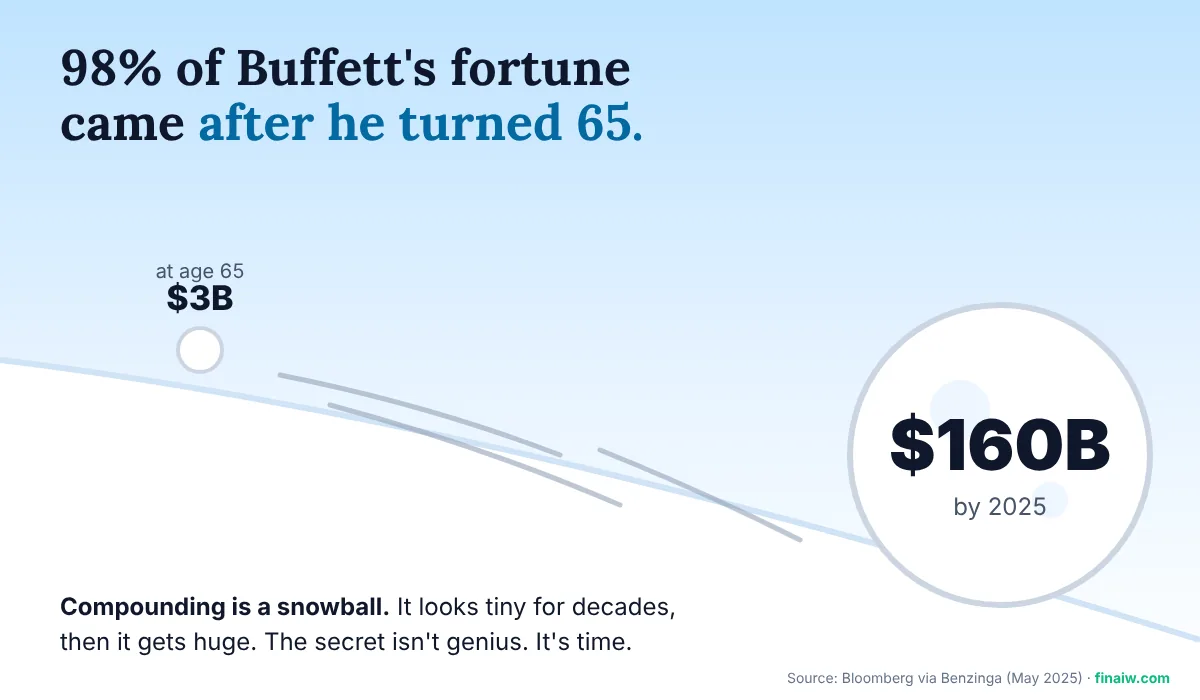
- Time does the heavy lifting. Warren Buffett had about $3 billion at age 65. By 2025, Bloomberg put his fortune at about $160 billion. In other words, roughly 98% of his wealth arrived after his 65th birthday. He's a brilliant investor, but the real secret is that he started investing as a boy and never stopped.
The 5 habits that beat a big salary
1. Wealth is the money you don't see. We judge people by what they spend: the car, the house, the watch. But spending is the opposite of wealth. Every rupee, dollar or dirham you spend to look rich is one that can't grow. Ronald Read looked poor and was rich. Plenty of people look rich and are one bad year away from trouble.
2. Give it time. More time than feels reasonable. Compounding is boring for the first 20 years and astonishing after 40. Grace Groner's $180 didn't look like much in 1945 or 1965. Time is the one ingredient you can't buy later, which is why starting small today beats starting big "when I earn more".
3. Own good businesses and leave them alone. Read and Bloom owned real companies and held them for decades. Today, the simplest version of this is a low-cost index fund or a diversified mutual fund through a monthly SIP: you own hundreds of businesses at once and don't need to pick winners.
4. Don't let your lifestyle grow as fast as your income. Every raise is a choice: upgrade your life, or upgrade your future. You can do some of both. Fuscone's mistake wasn't enjoying his money. It was building a life so expensive that one bad year could knock it down.
5. Avoid debt that can force your hand. Read could ride out any crash because nobody could force him to sell. Fuscone couldn't, because his lenders could. The best investment plan in the world fails if a loan payment makes you sell at the bottom.
An honest word before you start
Two things these stories don't tell you.
First, we only hear about the Ronald Reads whose stocks worked out. Plenty of careful savers picked the wrong companies. That's exactly why, for most people, a diversified fund beats trying to copy someone's stock list.
Second, you don't need safety pins on your coat. Read and Groner chose extreme frugality; you don't have to. The lesson isn't "never spend". It's "spend on purpose, invest first, and give it decades".
What this looks like for you
You don't need a janitor's discipline or a banker's salary. You need a fixed amount, invested every month, for a long time. At an 8% average yearly return (not guaranteed):
| Invested every month | After 20 years | After 30 years | After 40 years |
|---|---|---|---|
| 100 | about 59,000 | about 150,000 | about 351,000 |
| 200 | about 119,000 | about 300,000 | about 703,000 |
| 500 | about 296,000 | about 750,000 | about 1,757,000 |
| 1,000 | about 593,000 | about 1,500,000 | about 3,514,000 |
The numbers work in any currency. Look at the last column: a modest amount, left alone long enough, becomes something that changes a life, or a whole town's library.
Try your own numbers with the FINAIW SIP Calculator. If you want a target to aim for, read How much to invest to become a millionaire or How much to save for retirement by age.
Find your exact number in 30 seconds.
Plug in your own timeline and return assumption — the FINAIW SIP Calculator works in any currency.
Open the SIP Calculator →Frequently asked questions
Who was Ronald Read?
A gas station attendant and janitor from Brattleboro, Vermont, who died in 2014 aged 92 with an estate of about $8 million, built by buying and holding dividend-paying stocks for decades. He left $6 million to his local hospital and library.
Can you really get rich on an average salary?
Many people do. In a survey of more than 10,000 US millionaires, 79% inherited nothing and only 31% averaged $100,000 a year in income. Steady investing over decades matters more than a high salary.
Why do high earners go broke?
Usually because spending and debt grow as fast as income, leaving no buffer when something goes wrong. A study of NFL players found about 1 in 6 filed for bankruptcy within 12 years of retiring, regardless of how much they had earned.
How much of Warren Buffett's wealth came after 65?
About 98%. He had roughly $3 billion at 65 and about $160 billion by 2025, mostly because he kept compounding for decades.
What is the simplest way to start?
Pick an amount you can invest every month without fail, put it into a low-cost diversified fund, and increase it whenever your income rises. Then leave it alone for as long as you can.
The bottom line
Ronald Read never earned a big salary. He earned a little, spent less, invested the difference in good businesses, and gave it decades. That's not a secret, and it's not luck. It's a choice, and it's one you can start making this month.
See what your monthly amount could become with the FINAIW SIP Calculator →
Disclaimer: This article is for education only and is not investment advice. Past results, including the stories here, don't guarantee future returns, and investments can lose value. Figures in the table assume a constant return compounded monthly. Please speak to a licensed adviser in your country for personal advice.
Find your exact number in 30 seconds.
Plug in your own timeline and return assumption — the FINAIW SIP Calculator works in any currency.
Open the SIP Calculator →