How Much Should You Invest for Retirement, by Age?
By FINAIW Team · Reviewed by Nishit B, Founder, and Shilp G, Co-founder · Updated October 29, 2026 · 7 min read
For every 100,000 a year you plan to spend in retirement, you need a corpus of about 2,500,000 — the standard "25 times annual expenses" target behind both the 4% rule and the FIRE movement. What changes everything is when you start investing toward it, via a monthly investment that compounds over time. Starting at 25 instead of 45 needs roughly a sixth of the monthly amount, for the exact same retirement target.
Below is the monthly investment needed to hit that target, by the age you start, assuming you retire at 65 — plus what happens if you wait, and the one real limitation of this kind of table.
How much you need to invest monthly, by starting age
Figures are the monthly investment needed per 100,000 of annual retirement expenses (a 2,500,000 target), retiring at 65, at a few common return assumptions:
| Start age | Years to invest | At 6% | At 8% | At 10% | At 12% |
|---|---|---|---|---|---|
| 25 | 40 | 1,249 | 711 | 392 | 210 |
| 30 | 35 | 1,746 | 1,083 | 653 | 385 |
| 35 | 30 | 2,476 | 1,666 | 1,097 | 708 |
| 40 | 25 | 3,590 | 2,611 | 1,869 | 1,317 |
| 45 | 20 | 5,384 | 4,216 | 3,265 | 2,502 |
| 50 | 15 | 8,554 | 7,177 | 5,982 | 4,955 |
| 55 | 10 | 15,179 | 13,575 | 12,103 | 10,760 |
| 60 | 5 | 35,654 | 33,799 | 32,017 | 30,308 |
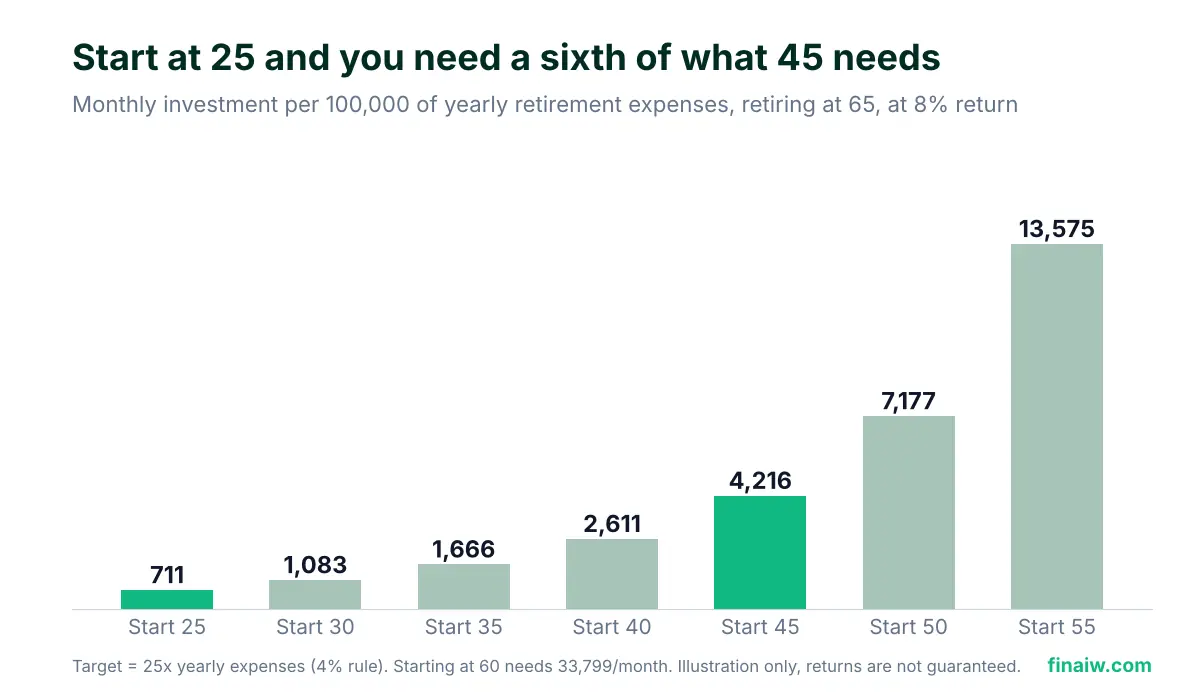
At 8%, starting at 25 instead of 45 needs 711 a month instead of 4,216 — about a sixth — for the identical 2,500,000-per-100,000-of-expenses target. That gap is entirely the effect of 20 extra years of compounding, not of investing more aggressively.
Want your own exact number? The FINAIW Retirement Calculator projects your corpus for any monthly amount, return and timeline, in any currency.
Find your exact number in 30 seconds.
Plug in your own monthly investment, return and years left — the FINAIW Retirement Calculator works in any currency.
Open the Retirement Calculator →Scale this to your own annual expenses
The table above is built per 100,000 of annual expenses specifically so it scales by simple multiplication — find your age and return assumption, then multiply by how many 100,000s you actually plan to spend per year in retirement.
Worked examples, all at 8% return:
- 600,000/year in expenses, starting at 30: 1,083 × 6 = about 6,500/month
- 1,200,000/year in expenses, starting at 35: 1,666 × 12 = about 20,000/month
- 300,000/year in expenses, starting at 25: 711 × 3 = about 2,130/month
For Indian rupees and lakhs: if you plan to spend ₹6,00,000 a year (₹50,000/month) in retirement, your 25x target is ₹1.5 crore. In higher-inflation economies like India, planners typically assume a higher nominal return — 10–12% rather than 6–8% — since the same inflation that erodes purchasing power also tends to lift nominal investment returns.
Where the "25x annual expenses" number comes from
This is the same 4% rule used by the FIRE Calculator: if you can live on withdrawing 4% of your portfolio a year, your portfolio needs to be 25 times your annual expenses (1 ÷ 0.04 = 25), because that withdrawal rate is historically unlikely to deplete the portfolio over a long retirement. It's a planning heuristic, not a guarantee — some planners now suggest a more conservative 3.25–3.5% (a 29–31x multiple) for very long retirements, given today's market valuations and lower expected bond returns than when the original research was done.
What you actually invest vs. what compounding adds
The later you start, the more of your own money — not investment growth — has to do the work:
| Start age | You invest (total) | Target corpus | From compounding |
|---|---|---|---|
| 25 | 341,000 | 2,500,000 | 2,159,000 (86%) |
| 35 | 600,000 | 2,500,000 | 1,900,000 (76%) |
| 45 | 1,012,000 | 2,500,000 | 1,488,000 (60%) |
| 55 | 1,629,000 | 2,500,000 | 871,000 (35%) |
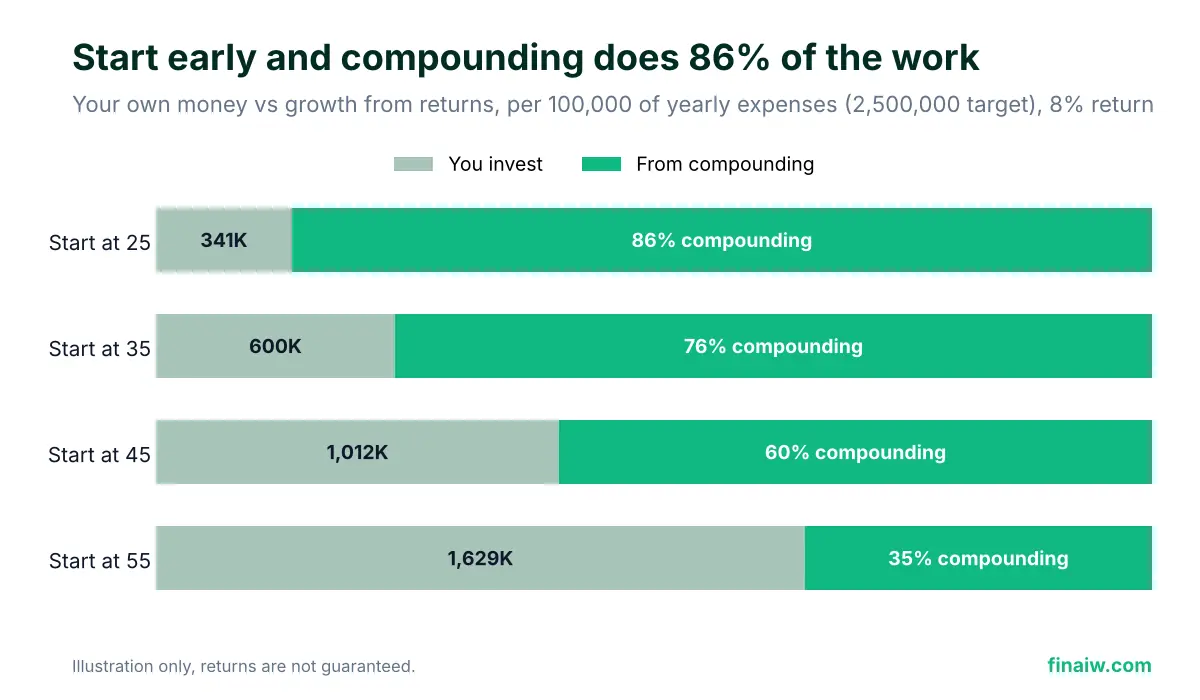
(All figures per 100,000 of annual expenses, at 8% return.) Starting at 25, compounding does 86% of the work. Starting at 55, you're funding 65% of your own retirement out of pocket, with compounding doing comparatively little — there simply isn't enough time left for it to take over.
The cost of waiting 5 years
Every 5 years you delay starting raises the required monthly amount by more than you'd expect, because you're losing time at both ends — less time to compound and less time to spread the same target over:
| Start age | Monthly investment (per 100,000 expenses, 8%) |
|---|---|
| 25 | 711 |
| 30 | 1,083 (+52%) |
| 35 | 1,666 (+54%) |
| 40 | 2,611 (+57%) |
| 45 | 4,216 (+62%) |
| 50 | 7,177 (+70%) |
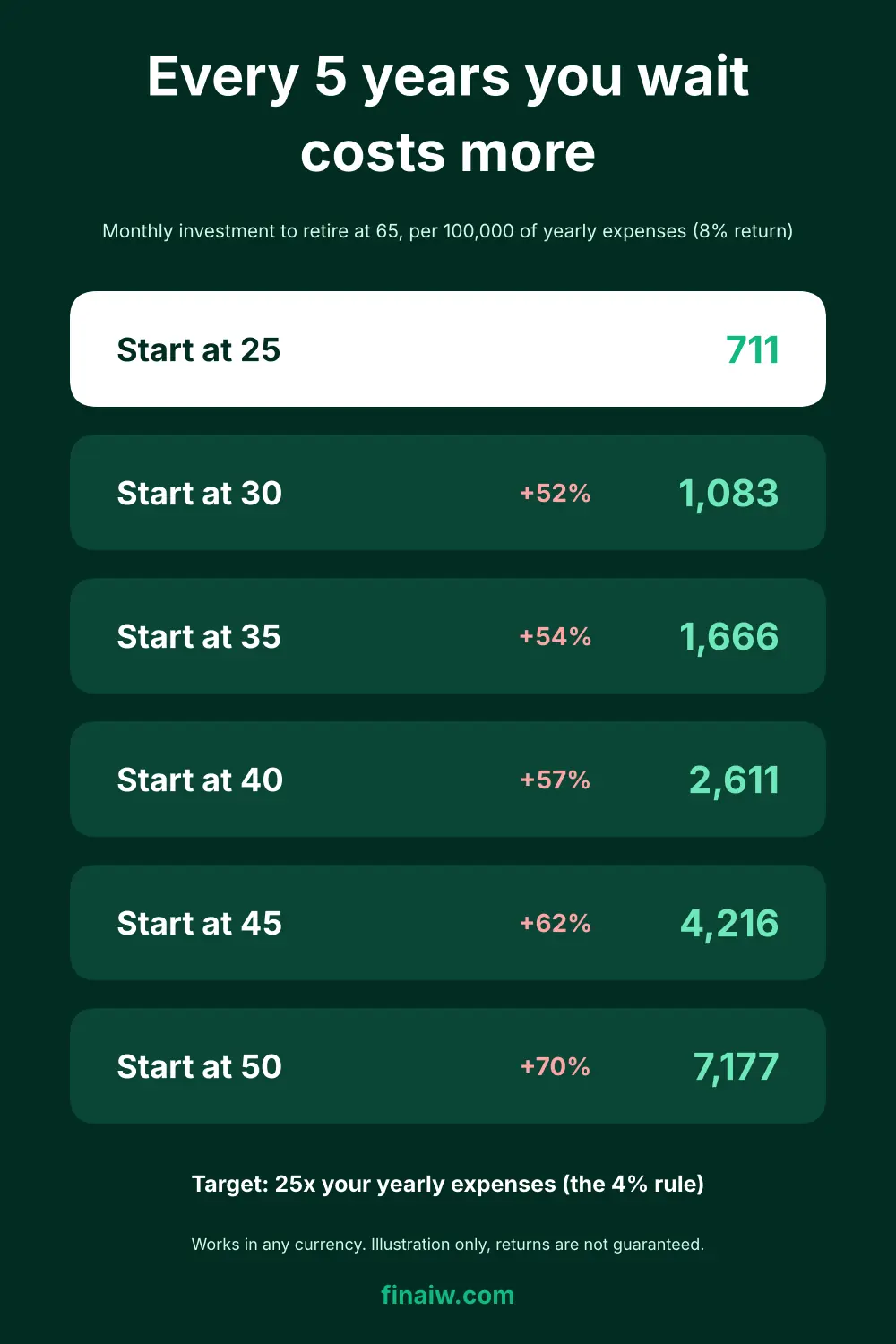
Each 5-year delay costs more than the one before it, as a percentage. Waiting from 25 to 30 adds 52%; waiting from 45 to 50 adds 70%, for the same 5 years.
How much should you have saved by each age?
If you start at 25 and invest 711 a month per 100,000 of yearly expenses at an 8% return, this is the balance that keeps you on track for the 2,500,000 target at 65:
| Age | Balance to be on track (per 100,000 of yearly expenses) |
|---|---|
| 30 | about 53,000 |
| 35 | about 131,000 |
| 40 | about 248,000 |
| 45 | about 422,000 |
| 50 | about 681,000 |
| 55 | about 1,067,000 |
| 60 | about 1,642,000 |
| 65 | 2,500,000 |
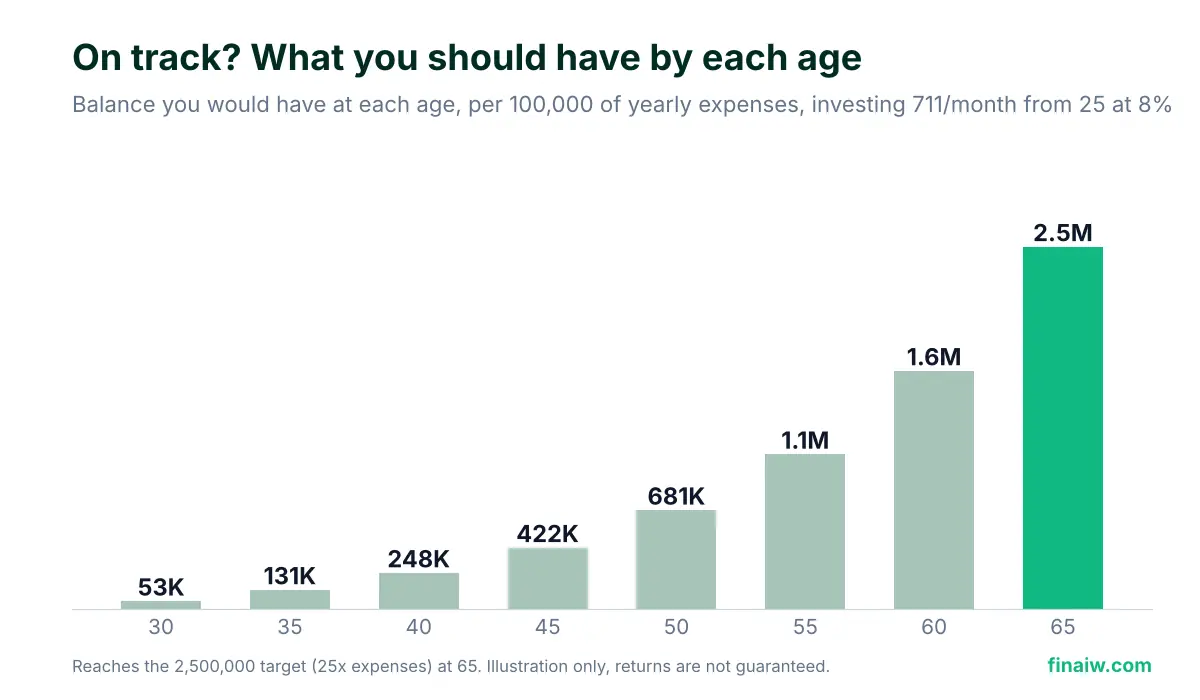
If you're behind these numbers, use the starting-age table above from your current age, minus what you've already saved.
A popular salary-based rule of thumb from Fidelity: aim to have about 1x your salary saved by 30, 3x by 40, 6x by 50, 8x by 60 and 10x by 67. It assumes you save 15% of your income from age 25 and retire at 67.
What this table doesn't include: inflation
Every figure here is in today's money, not inflation-adjusted — the same limitation the Retirement Calculator itself discloses. A 100,000-a-year lifestyle today will cost more than 100,000 a year by the time you actually retire, so your real target should be based on what 100,000 of today's spending will actually cost at your retirement age, not the number itself. Run your expense figure through the Inflation Calculator first — then apply the 25x multiple and this table to that inflation-adjusted figure, not to today's expenses directly.
Frequently asked questions
How much should I save for retirement by age 30?
Using the 25x-expenses target at an 8% return, about 1,083 a month for every 100,000 of annual retirement expenses, retiring at 65. For 600,000 in annual expenses, that's about 6,500 a month.
How much should I save for retirement by age 40?
About 2,611 a month per 100,000 of annual expenses at 8% return, roughly 3.7 times more than starting at 25, for the same eventual target.
How much should I have saved for retirement by 40?
On a 25x-expenses plan started at 25, about 248,000 per 100,000 of yearly expenses (8% return). Fidelity's salary rule suggests about 3x your annual salary by 40.
What is the 25x rule for retirement?
Your retirement corpus should be about 25 times your annual expenses, derived from the 4% rule — withdrawing 4% of a portfolio a year is historically unlikely to deplete it over a long retirement. 1 ÷ 0.04 = 25.
Is 8% a realistic return assumption for retirement investing?
It's a common planning figure for a stock-heavy portfolio over long periods in lower-inflation economies (the US, UK, EU), but isn't guaranteed. Higher-inflation economies like India typically plan around 10–12% nominal returns instead. Plan with a range rather than a single number.
Does this account for inflation?
No — these are nominal, today's-money figures, same as the Retirement Calculator itself. Run your expected annual expenses through the Inflation Calculator to project what they'll actually cost at your retirement age, then apply the 25x target to that adjusted figure.
Related: The janitor who died with $8 million
The bottom line
The 25x-annual-expenses target is the same standard used by the FIRE movement and most retirement planners — what actually determines your monthly investment is almost entirely when you start, not how aggressively you invest later. Starting at 25 needs roughly a sixth of what starting at 45 needs, for the identical eventual target.
Want a round-number goal instead? See How much to invest to become a millionaire.
Project your own retirement corpus with the FINAIW Retirement Calculator →
New to the 4% rule? Read our lesson on FIRE: Financial Independence, Retire Early.
Disclaimer: This article is for education only and is not financial advice. Figures are illustrations using the standard 4%-rule (25x expenses) target and a constant-return compounding formula; real returns vary, investments can lose value, and the 4% rule itself is a historical guideline, not a guarantee. Please speak to a licensed financial adviser in your country for personal retirement planning advice.
Find your exact number in 30 seconds.
Plug in your own monthly investment, return and years left — the FINAIW Retirement Calculator works in any currency.
Open the Retirement Calculator →