How Am I Doing Financially for My Age? Take the 5-Point Check
By FINAIW Team · Reviewed by Nishit B, Founder, and Shilp G, Co-founder · Updated November 13, 2026 · 6 min read

You're scrolling late at night. Someone your age just announced they've paid off their home loan. Another is "retiring at 40". And you're quietly wondering whether you're doing fine, or whether you missed something everyone else seems to know.
Here's the short answer: most people are doing better than they fear, and worse than they could with a few small changes. The way to find out which applies to you is not to compare yourself with one friend's highlight reel. It's to check five numbers against honest benchmarks for your age. It takes about two minutes.
Start with the calculator below. Enter your age, income, savings, investments and debt, and you'll get your "financial age": how old your money habits make you, compared with your real age.
Disclaimer: This is a motivational comparison tool, not a precise actuarial or financial planning measure.
Your actual financial standing depends on many factors this simplified score doesn't capture.
Financial Age
20
Wealth Score
37
Savings Rate
30%
Net Worth
₹2,00,000
Wealth Score
37
Financial Analysis
Financial Explorer
Your financial behavior suggests that you are currently Ahead For Your Age. Your savings habits, net worth, and investment growth indicate your long-term wealth-building potential.
Wealth Optimization
Increasing your monthly savings rate can significantly reduce your financial age and accelerate your path toward financial freedom.
Recommendation
Focus on growing investments while reducing high-interest debt to improve your overall wealth score over time.
Financial Discipline
Consistent investing and controlled spending habits are what currently support your long-term wealth creation journey.
Future Potential
Your current financial pattern suggests strong future compounding opportunities if maintained consistently.
Then use the five checks below to see exactly where you're ahead and where you're behind.
The 5-point financial check by age
| Your age | Net worth: typical (US median) | Retirement savings goal | Savings rate goal | Emergency fund | High-interest debt |
|---|---|---|---|---|---|
| Under 35 | $33,000 | 1× salary by 30 | 15% of income | 3–6 months of expenses | None |
| 35–44 | $155,600 | 3× salary by 40 | 15% of income | 3–6 months of expenses | None |
| 45–54 | $253,700 | 6× salary by 50 | 15% of income | 3–6 months of expenses | None |
| 55–64 | $411,900 | 8× salary by 60 | 15% of income | 3–6 months of expenses | None |
| 65+ | $431,300 (65–74) | 10× salary by 67 | — | 3–6 months of expenses | None |
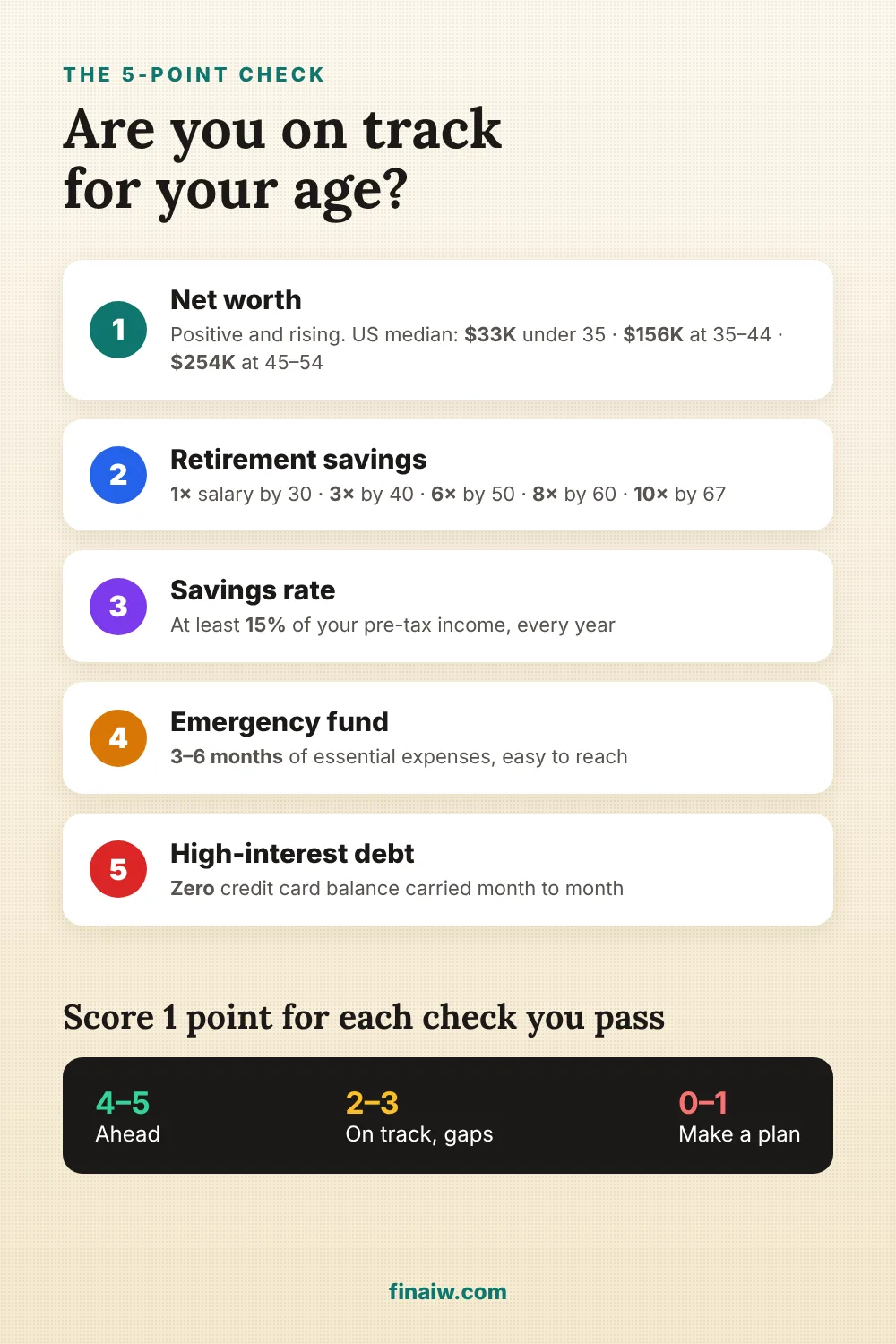
Score one point for each check you pass. 4–5 points: you're ahead. 2–3: on track, with gaps to fix. 0–1: time for a plan, and the order below tells you where to start.
Check 1: Is your net worth in line with people your age?
Net worth is everything you own minus everything you owe. The best benchmark is the median, the household exactly in the middle, not the average, which a few very rich families drag up.
The newest US figures come from the Federal Reserve's 2025 Survey of Consumer Finances, released in October 2026. The typical family headed by someone under 35 had $33,000. At 35–44 it was $155,600, and at 55–64 it was $411,900.
Outside the US, the numbers differ because surveys differ:
- United Kingdom: households headed by 25 to 34-year-olds had a median of almost £77,000, and 35 to 44-year-olds nearly £200,000 (ONS, 2018–2020, including pensions).
- Canada: families whose main earner was under 35 had a median of C$159,100, and all families C$519,700 (Statistics Canada, 2023).
Pass if: your net worth is positive and higher than it was a year ago. Being above the median for your age is a bonus, not the bar.
Want to see exactly where you rank? Try the Net Worth Percentile calculator, or read net worth by age for the full breakdown.
Check 2: Are your retirement savings on pace?
Fidelity's widely used guideline is to have about 1× your salary saved for retirement by 30, 3× by 40, 6× by 50, 8× by 60 and 10× by 67. It assumes you start saving at 25 and retire at 67.
Pass if: your retirement savings are at or near the multiple for your age. If you're behind, the gap closes faster than you'd think once you raise your monthly amount, because compounding does more of the work each year.
See your own numbers with the Retirement Calculator, or read how much to save for retirement by age.
Check 3: Are you saving at least 15% of your income?
Fidelity suggests saving 15% of your pre-tax income for retirement each year, including any employer contribution. Your savings rate matters more than your salary. Someone earning 50,000 who saves 20% builds wealth faster than someone earning 100,000 who saves 5%.
Pass if: you save 15% or more. Under 10%? Start by moving 1% more each time your pay rises. You won't feel it, and in five years you'll be there.
Check 4: Could you survive three months without income?
An emergency fund is money set aside for a job loss, a medical bill or a broken car. The common guideline is 3 to 6 months of essential expenses, kept somewhere safe and easy to reach.
Pass if: you have at least 3 months covered. This one matters more than it looks: without a buffer, one bad month turns into credit card debt, which undoes every other check.
Find your target with the Emergency Fund Calculator.
Check 5: Are you free of high-interest debt?
A home loan at a reasonable rate is normal at most ages. Credit card balances and expensive personal loans are different. Credit card interest is often above 20% a year, and in some countries over 36%. No investment reliably beats that.
Pass if: you carry no credit card balance from month to month and have no high-interest personal loans.
Behind on this one? Fix it first. Paying off a 24% card is a guaranteed 24% return.
What to fix first if you're behind
Work through the checks in this order. Each one protects the next:
- Clear high-interest debt. It's an emergency that compounds against you.
- Build 3 months of expenses as an emergency fund. It stops new debt from appearing.
- Raise your savings rate toward 15%. Automate it so it happens before you can spend it.
- Let retirement savings and net worth grow. Checks 1 and 2 take care of themselves when 3, 4 and 5 are in place.
Frequently asked questions
How do I know if I'm doing well financially for my age?
Check five things: net worth compared with the median for your age, retirement savings compared with your salary, a savings rate of at least 15%, an emergency fund of 3 to 6 months, and no high-interest debt. Passing four or five means you're ahead of most people your age.
Where should I be financially at 30?
A common benchmark is about one year's salary saved for retirement by 30, a positive and rising net worth, 3 to 6 months of expenses in an emergency fund, and no credit card debt. The typical US family headed by someone under 35 has a net worth of $33,000.
Where should I be financially at 40?
Fidelity's guideline is about three times your salary saved for retirement by 40. The median US family aged 35 to 44 has a net worth of $155,600.
Is it too late to catch up financially at 40 or 50?
No. A higher savings rate, cleared debt and steady investing can close much of the gap, and many people do most of their wealth building after 40. The key is to start with the checks you're failing, in the order above.
What is a wealth age calculator?
It compares your "financial age", based on your savings rate and net worth, with your real age. A financial age below your real age means your money habits are ahead of where they need to be.
The bottom line
You're not behind because a friend posted a new car. You're behind only if your own five numbers say so, and the fix is usually the same: clear expensive debt, build a buffer, and save a little more each year. Check again in twelve months. The person to beat is you, last year.
Get your financial age with the Wealth Age Calculator →, then see where you rank globally →.
Sources: Federal Reserve, "Changes in U.S. Family Finances from 2022 to 2025" (October 2026); Office for National Statistics, Total wealth in Great Britain, April 2018 to March 2020; Statistics Canada, Survey of Financial Security 2023; Fidelity, "How much do I need to retire?" and "How much should I save for retirement?"
Disclaimer: This page is for education only and is not financial advice. Benchmarks describe groups, not individuals, and vary by country. Please speak to a licensed adviser in your country for personal advice.