How Much Do You Need to Earn to Be in Canada's Top 1%?
By FINAIW Team · Reviewed by Nishit B, Founder, and Shilp G, Co-founder · Updated November 13, 2026 · 5 min read
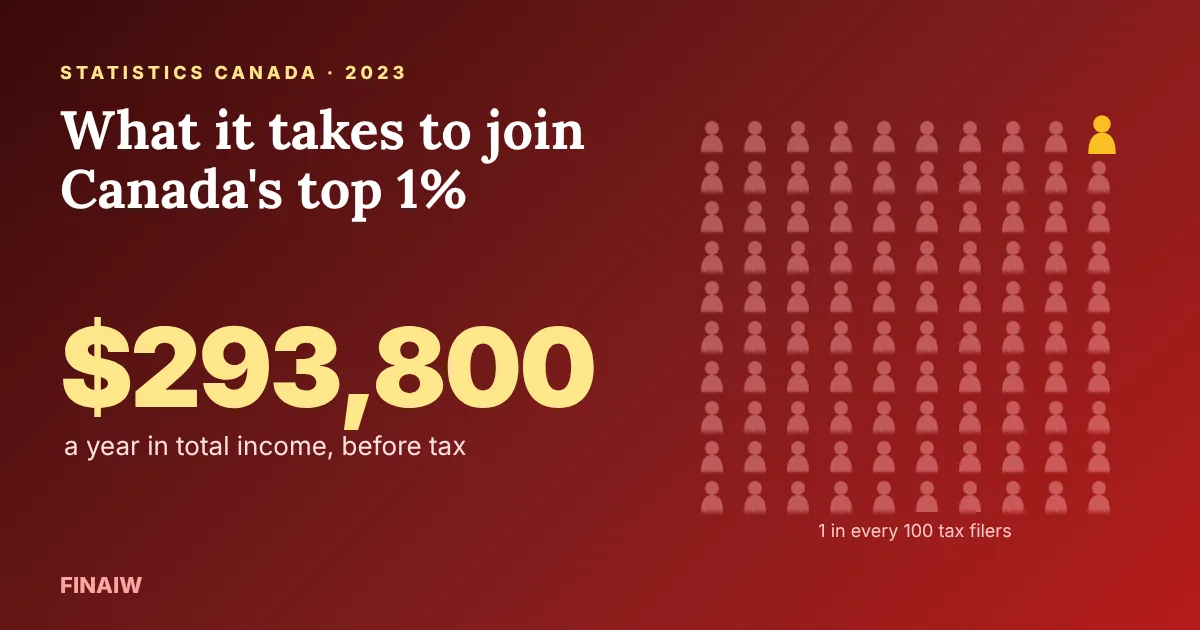
To be in Canada's top 1% of earners, you needed a total income of at least $293,800 in 2023. That's according to Statistics Canada's latest tax-filer data, released in October 2025. To reach the top 0.1%, you needed $930,100.
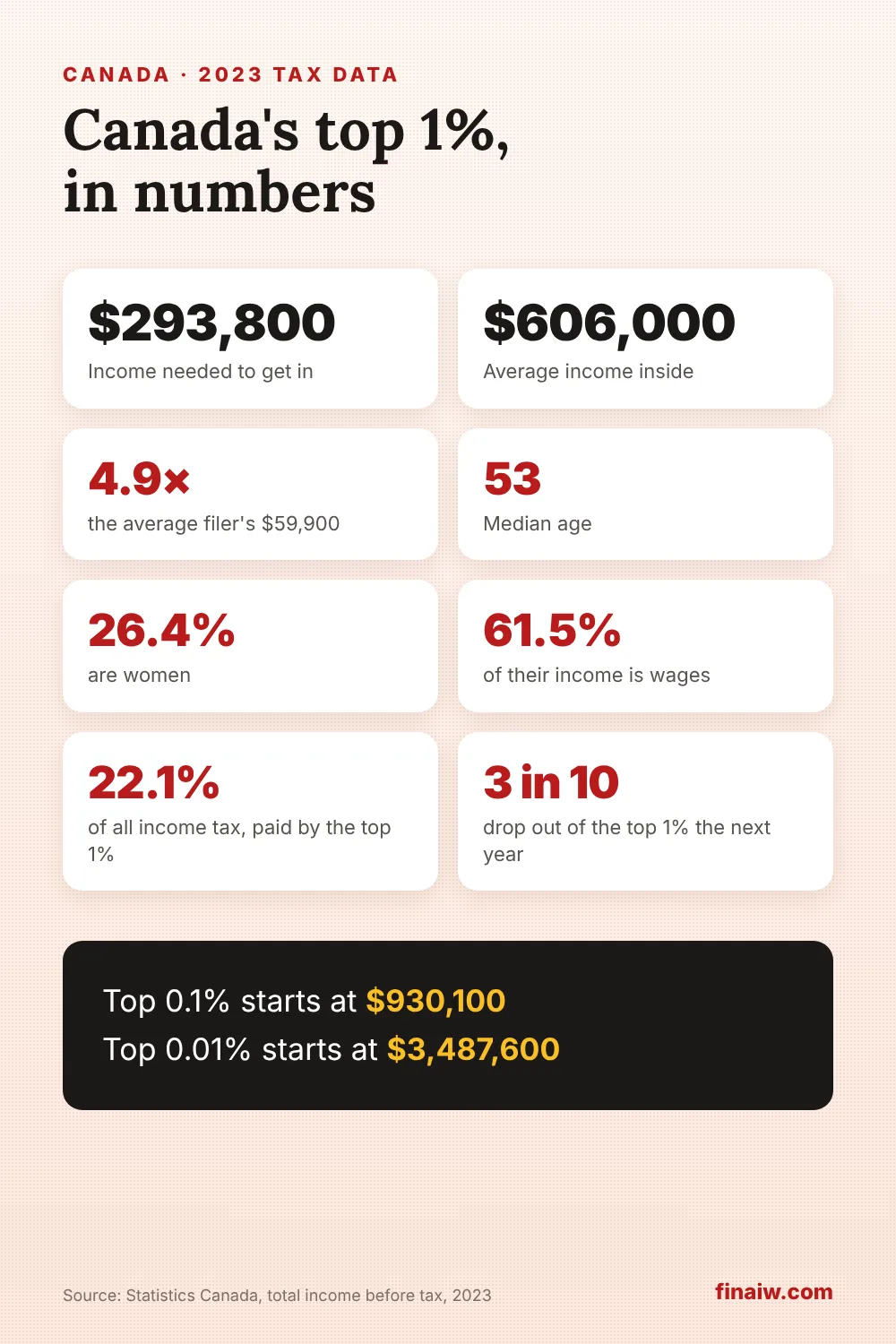
For context, the average Canadian tax filer had a total income of $59,900. So the door to the top 1% opens at almost 5 times the average income, and the average person inside earns about 10 times it.
Check your own income below. Enter your yearly income before tax to see how it compares with Canada's top earners, and with every working adult in the world.
Enter your yearly income to see how it compares with Canada's top earners.
Based on Statistics Canada 2023 tax-filer data. Total income includes wages, investments, pensions and government transfers.
Canada's top-income cutoffs, 2023
| Group | You need to earn at least | People in the group |
|---|---|---|
| Top 1% | $293,800 | 310,660 |
| Top 0.1% | $930,100 | about 31,000 |
| Top 0.01% | $3,487,600 | about 3,100 |
Total income before tax, 2023. Source: Statistics Canada, High-income tax filers in Canada (released 31 October 2025). The 0.1% and 0.01% headcounts are approximate, worked out from the top 1% total.
"Total income" counts more than salary. It includes employment and self-employment income, investment income, pensions, support payments, other taxable income and government transfers.
What Canada's top 1% looks like
The numbers behind the cutoff are more interesting than the cutoff itself:
- The average top 1% earner made $606,000 in 2023, and the median was $402,900. A handful of very high incomes pull the average up, just as they do in net worth data.
- Most of it is still a paycheque. Wages and salaries made up 61.5% of top 1% income in 2023, down from 64.3% in 2016. The rest comes mostly from investments and business income.
- They're mostly in their 50s. The median age of the top 1% was 53.
- About one in four is a woman. Women made up 26.4% of the top 1% in 2023, up from 25.6% a year earlier.
- They earn 10.1% of all income and pay 22.1% of all income tax. The average top 1% earner paid $235,600 in federal and provincial income tax.
- It isn't permanent. Only 70.9% of people in the top 1% were still there the following year. Roughly three in ten drop out each year as bonuses, business profits or one-off gains come and go.
Top 1% income by province
Statistics Canada reports the average income of the top 1% in each province. These are averages, not entry cutoffs:
| Province | Average total income of the top 1% (2023) | Average wages and salaries of the top 1% |
|---|---|---|
| Alberta | $644,400 | $413,900 |
| Ontario | $623,200 | $396,200 |
| British Columbia | $596,300 | $344,200 |
| Quebec | $570,100 | $325,700 |
Alberta's top 1% also had the highest average wages, at $413,900. Ontario has the most stable top 1%: 72.5% of its top earners stayed in the group the following year, the highest of any province.
Not in the top 1%? You're probably richer than you think
An income well below Canada's cutoff can still rank high on the global ladder. Use the Global Income Percentile calculator to see where your income ranks against every working adult in the world. Then check your wealth, not just your income, with the Net Worth Percentile calculator.
High income and high net worth aren't the same thing. Plenty of top earners spend most of what they make, while steady savers on ordinary salaries build real wealth. Read the janitor who died with $8 million for proof.
Frequently asked questions
How much do you need to make to be in the top 1% in Canada?
At least $293,800 in total income before tax, based on Statistics Canada's 2023 data. That's almost five times the average tax filer's income of $59,900.
What income is top 0.1% in Canada?
$930,100 or more in 2023. The top 0.01% started at $3,487,600.
How many people are in Canada's top 1%?
310,660 tax filers in 2023.
What is the average income of the top 1% in Canada?
$606,000 in 2023. The median within the group was $402,900, because a small number of very high earners pull the average up.
Which province has the highest-earning top 1%?
Alberta, where the top 1% averaged $644,400 in 2023, followed by Ontario at $623,200.
The bottom line
Canada's top 1% starts at $293,800, but most people who reach it are in their 50s, and nearly three in ten fall out the following year. Income is only half the story. What builds lasting security is how much of it you keep and invest.
See where your income ranks worldwide with the Global Income Percentile calculator →, then take the 5-point financial check for your age →.
Source: Statistics Canada, "High-income tax filers in Canada, 2023", The Daily, 31 October 2025, Tables 1 and 2 and table 11-10-0055-01. All dollar figures are Canadian dollars, total income before tax.
Disclaimer: This page is for education only and is not financial or tax advice.